


The digital economy has transformed how businesses sell, deliver, and monetize products and services. It has also reshaped U.S. sales tax compliance and brought more attention to digital services tax rules around the world. For decades, states generally could only require sellers to collect sales tax if they had a physical presence in the state, such as an office, warehouse, inventory, or employees. But in the current world of e-commerce, digital downloads, streaming, and online marketplaces, this doesn’t make sense anymore.
In 2018, the U.S. Supreme Court decision in South Dakota v. Wayfair, Inc. did away with the physical presence requirement and allowed states to require remote sellers to collect sales and use tax based on economic activity. Today, 45 states and the District of Columbia impose sales tax, and there are more than 13,000 taxing jurisdictions across the country. While thresholds vary, many states use a standard of $100,000 in sales or 200 separate transactions within a 12-month period.
Economic nexus
Economic nexus means a business may have a sales tax obligation in a state even if it has no people, property, or office there. If a seller exceeds a state’s revenue or transaction threshold, it may be required to register, collect tax, file returns, and maintain records for that state.
It’s important to understand that the thresholds are often based on gross sales, not just taxable sales, so exempt sales, nontaxable services, or marketplace sales may still need to be reviewed depending on the state’s rules.
Impact of marketplace facilitator laws
Marketplace facilitator laws created another major shift. Platforms like Amazon, Etsy, eBay, and Walmart are generally responsible for collecting and remitting sales tax on transactions they facilitate. This change simplified compliance for many marketplace sellers, but it did not eliminate seller responsibility entirely.
A common misconception is that “the marketplace handles my sales tax, so I am covered.” In reality, businesses still need to evaluate direct website sales, non-marketplace channels, registration requirements, filing obligations, and nexus tracking. For businesses that sell through both marketplaces and their own website, compliance can become tricky.
SaaS sales tax and digital product taxes
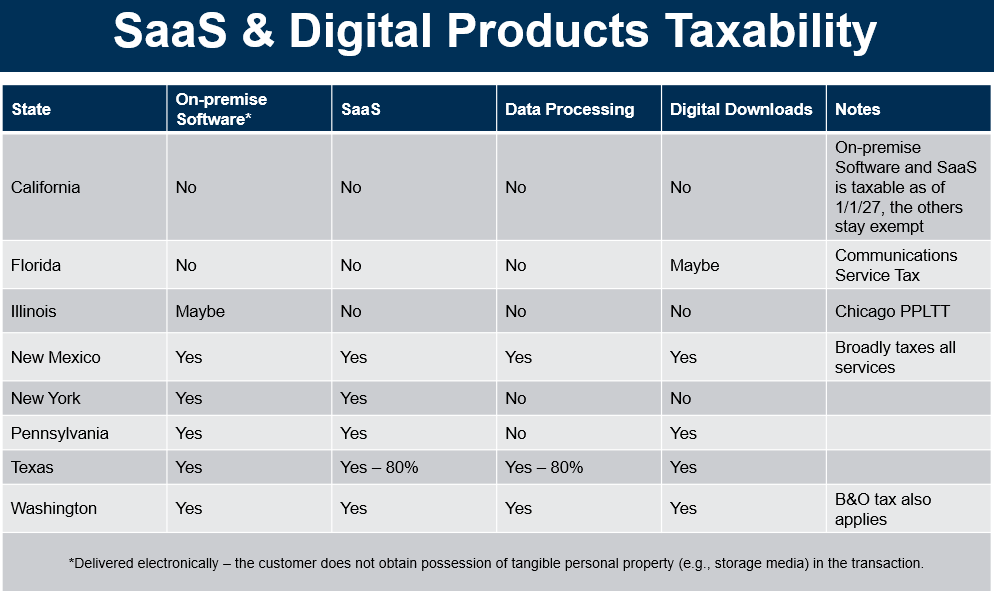
States are also broadening their tax bases to capture digital goods and services, but the rules vary dramatically. Some states treat digital products as tangible personal property because they are “perceptible to the senses.” Others create separate tax categories for digital products or specifically list certain digital services as taxable. Subscription-based software-as-a-service (SaaS), streaming services, digital downloads, data processing, and online services can all be taxed differently from one state to the next.
These differences make product classification one of the most important parts of digital sales tax compliance. A SaaS product may be taxable in one jurisdiction and exempt in another. Services like hosting, consulting, training, or support may also become taxable depending on how they are billed and whether they are tied to the sale of software.
Cross-border digital sales
Digital tax obligations don’t stop at U.S. borders. More than 100 countries require foreign digital service providers to register for VAT (Value Added Tax) or GST (Goods and Services Tax). In the European Union, zero-threshold rules can apply from the first euro of B2C digital sales. Similar rules can apply to nonresident suppliers making B2C sales into the United Kingdom:
- Reverse charge mechanism: When supplying digital services to a VAT-registered business in the EU or UK, you do not charge or collect VAT. Instead, the responsibility shifts to the buyer, who self-assesses the VAT through the "reverse charge" process.
- Third-party sellers: If you sell digital services or subscriptions through a third-party electronic platform or marketplace (like an app store), the platform is typically responsible for accounting for and remitting the VAT.
For U.S. companies selling digital services globally, this creates a dual compliance challenge: domestic sales tax obligations in the United States and VAT/GST obligations in foreign jurisdictions. B2B transactions may be simplified through reverse charge rules, but B2C sales often require registration, tax collection, remittance, and ongoing reporting. For many digital businesses, cross-border compliance now includes both indirect tax rules, such as VAT/GST, and digital services tax considerations.
Digital service tax rules
Digital services taxes, or DSTs, are separate from sales tax, VAT, and income tax. These taxes are generally imposed by individual countries on gross revenue earned from certain digital activities, such as online advertising, digital marketplaces, streaming services, and the sale or monetization of user data.
The key difference is that DSTs are usually based on revenue rather than profit. That means a company may owe tax in a country even if it is not profitable there. DSTs are also typically not creditable against corporate income tax in the company’s home country, which can create a double-tax cost.
With DSTs, governments are trying to adapt tax systems to digital business models. As countries keep working through global tax rules and creating their own approaches, businesses should expect this area to remain uncertain for now.
State digital advertising taxes
The U.S. doesn’t currently have a federal digital services tax, but some states have created digital advertising taxes or expanded tax regimes for digital services. Maryland was the first state to enact a digital advertising tax, and other states have considered similar proposals. These rules have already faced legal challenges, including questions under the Internet Tax Freedom Act and the U.S. Constitution’s Commerce Clause.
For digital ad agencies and similar service providers, the issue can also overlap with sales tax. Website development, hosting, software, data processing, and other technology-enabled services may be taxable in some states depending on the specific facts, contract terms, and billing structure.
Compliance for digital sellers
Digital sellers should take a structured approach to sales tax compliance. The first step is a nexus analysis to figure out where your business has crossed economic thresholds. Next, you should review product taxability on a state-by-state basis, including software, SaaS, downloads, streaming, data processing, training, implementation, and other related services.
From there, evaluate exposure for historical periods, determine whether voluntary disclosure agreements may reduce penalties or limit lookback periods, and decide whether retroactive or prospective registration is appropriate. This analysis can also help improve systems, update invoicing, maintain exemption documentation, and prepare for future growth.
Sales tax compliance can affect pricing, contracts, product launches, technology systems, customer experience, and overall risk. Businesses should understand where they have nexus, how their products and services are taxed, what exposure may exist, and what steps you can take to build a practical compliance process as digital tax rules continue to change.